

Erstellt am: 3. 7. 2011 - 16:28 Uhr
"Ich hasse Parlamentarier"

Emmanuel Sigalas
Dr. Emmanuel Sigalas is a political scientist working at the Institut für europäische Integrationsforschung of the Österreichische Akademie der Wissenschaften. He is originally from Athens.
By Emmanuel Sigalas
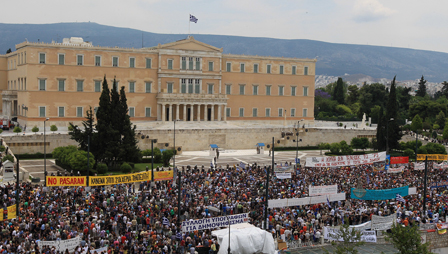
Last Wednesday was the day when the Greek members of Parliament were asked to vote on the fiscal austerity bill that would allow Greece to breathe financially, at least for a while. It was also the day of the most violent clashes between the police and the protesters so far. One of them said to international reporters: “I hate the parliamentarians. They are traitors”. These are harsh words; words that wouldn’t have been uttered before, even if the younger generation in Greece was mistrustful and sceptical of the politicians long before the breakout of the financial crisis.
But things are different now. The economic deadlock led to a political crisis which threatens Greek democracy as we knew it until recently. No, I am not suggesting that history is once more repeating itself. We are thankfully far away from the precarious years of the 1960s which led to the 7-year military junta. However, it would take a blind man or a fool not to see that something went terribly wrong in Greece. When politicians are attacked in the streets and when thousands of people try to physically block or even storm the parliament, then one knows that the Greek crisis is not just about economics. What is really at stake then? It is the legitimacy of the whole political system, a system that allowed bad economics and politics to fail Greece when it thought it was safely on the road to prosperity and security.
ANA-MPA / EPA / ORESTIS PANAGIOTOU
So it’s only natural that people in Greece are angry now. The demonstrators believe the established parties and the long-standing politicians betrayed them. They feel that their elected representatives lied to them, that they were only interested in their personal benefit, which included getting rich at the expense of public funds, and that they were living in their party politics bubble.
Such complaints are nothing new, neither are they an exclusive feature of Greek politics. However, when several thousands of people join the Syntagma square demonstrations shouting “thieves, thieves” outside the Greek parliament believing they are only doing their patriotic duty, it is clearly not business as usual for Greece.
I ask a friend of mine who was at Syntagma on Wednesday: why does he believe that it’s just the politicians to blame for the crisis? After all, didn’t we vote for them in free and fair elections? And if it wasn’t us, the younger generation, wasn’t it the majority of other Greek citizens who voted for the same parties again and again over the past 30 years? Aren’t they to blame at all?
My friend, and other young people I talked or listened to, insists that he never voted for the two main political parties, “the family clans”, as he dismissively calls them because the names Papandreou and Karamanlis have dominated Greek politics for decades. Secondly, he argues, he cannot be held responsible for what the “masses” have decided in the past. I point out that whether we realise it or not, we are all part of the same masses and attending the mass demonstrations only serves to highlight this fact. But he is too agitated to hear me and it is hard to argue when the demonstration is in full swing.
Self-criticism is vital at this stage of the Greek and potentially pan-European crisis. At individual level no one wants to admit that they are also responsible for the mess Greece is in right now. But we all are. Since no one forced us to vote the way we did, we were either misled or we miscalculated – both unsatisfactory explanations considering that we were given a choice several times.
Some say, and it is hard not to see their point, that no matter what one voted in the elections it would have made little difference. People only vote once every four years in the context of an electoral system that blatantly favours single-party governments. In between, citizens can do little else than sit and watch. This is why many Greeks were less than enthusiastic with their government’s vice-president comment that “we ate [from the state coffers] together”. Obviously, self-criticism among elected politicians wouldn’t go to waste either.
.jpg "© DPA / EPA / ARNO BURGI")
DPA / EPA / ARNO BURGI
To be of any practical use to the Greek people, self-criticism should lead to reforms that have the potential of restoring the legitimacy of the parliamentary institutions. Citizens have to be convinced that their voice matters and that their interests are served properly. When they cast their vote in the elections they have to be assured that they are offered a meaningful choice. A closer fit between the distribution of parliamentary seats and popular vote would be a start.
At the same time the Greek parliament has to be upgraded into something more than the talking shop it currently is. Since government majority in the chamber (nearly) always guarantees a legislative draft will pass without the need for inter-party cooperation, parliamentary debates or questions contribute next to nothing in terms of promoting the public interest. Just a glimpse at the televised plenary debates is enough to realise that rhetorical skirmishes between MPs and group leaders offer little that is of interest or value to the citizens.
In any case, Greece has to go beyond the formalities of electoral and representative democracy and try to get a better grasp of its essence. Measures for greater transparency, accountability and responsiveness in all public authorities have to be established. Minister and MP immunity (and consequently impunity) should be the exception rather than the norm.
Greece is currently in the middle of a multi-faceted crisis. Its political leaders have to realise that people demand more and better democracy not just more money. The sooner political forces in Greece take the appropriate steps, the better for the political and economic stability of Greece and eventually of the European Union too.